
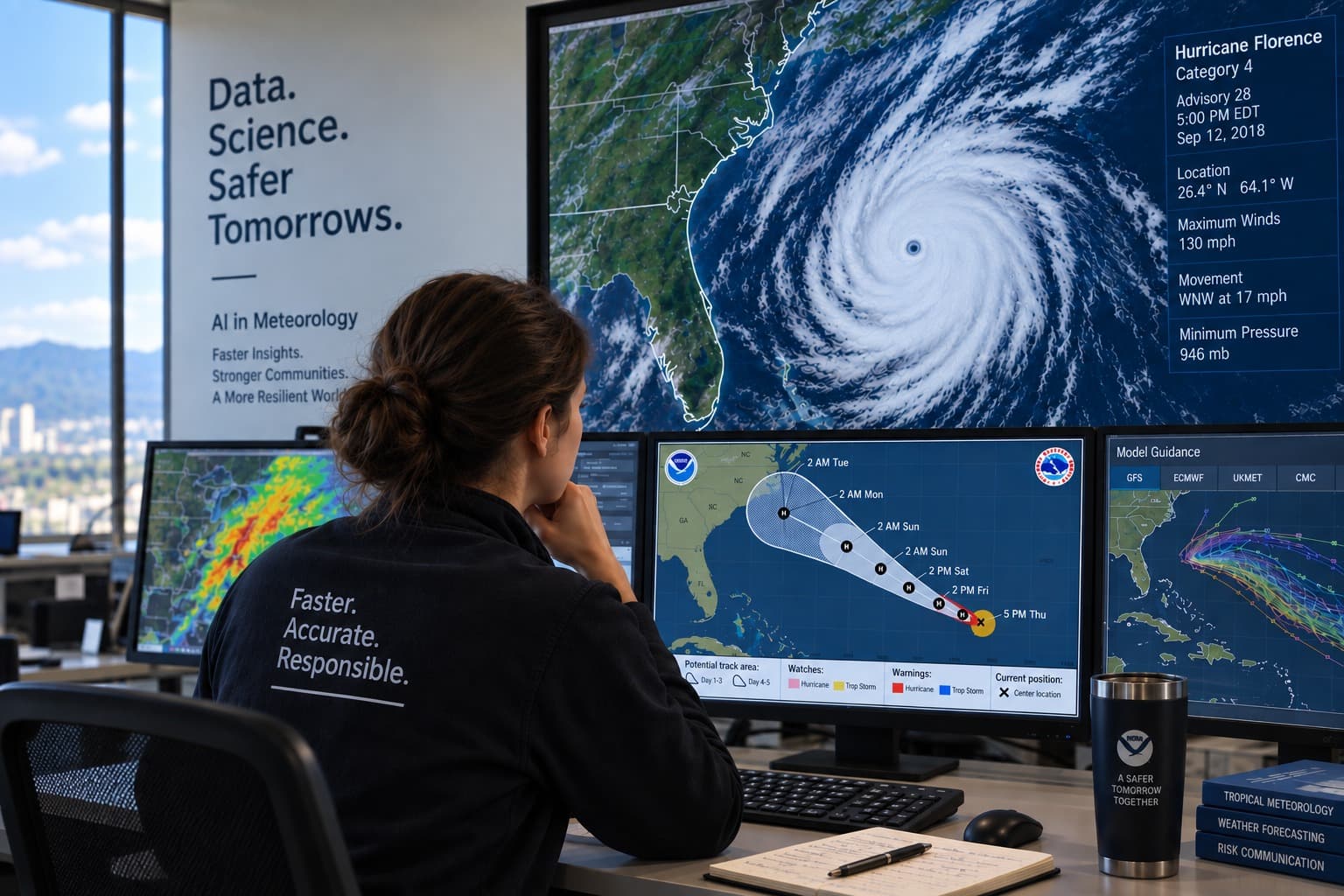

Artificial intelligence has rapidly risen as one of the most prominent conversation pieces in the STEM world, and meteorology is no exception.
There is no denying that AI is changing the way the meteorologists operate — from new machine-learning weather models to tools that can help meteorologists write code, analyze data, and build visualizations.
As AI increases in both functionality and usage, it is integral that it is used responsibly.
AI will not replace meteorologists, but its role in the ecosystem will continue to significantly evolve over the next few years. Let’s talk about it.
Numerical Weather Prediction With AI
AI is not new to meteorology. In fact, Dr. Andrew Mercer, a professor of meteorology at Mississippi State University, has been applying machine learning to meteorological problems for close to twenty years. His work has included everything from peak wind gust prediction to tropical cyclone rapid intensification, including research that explored how machine-learning guidance could eventually be incorporated into operational forecasting.
What is new is the scale at which AI is now being applied to numerical weather prediction.
Over the past handful of years, AI-based weather models have evolved from experimental research projects to serious competitors to traditional numerical weather prediction. Models such as GraphCast, Pangu-Weather, and FourCastNet have demonstrated impressive skill in global forecasting, while newer systems such as the Artificial Intelligence Global Forecasting System (AIGFS) and ECMWF’s AIFS are pushing AI-based forecasting toward operational use.
The reasoning behind the rise of these models is quite simple, but it might not be what you expect.
Traditional numerical weather prediction requires tremendous amounts of computing power to solve the physical equations governing the atmosphere. AI models take a different approach, learning atmospheric patterns from massive datasets and using that knowledge to generate solutions quicker.
Computational performance is merely half the battle, though.
AI models can struggle with certain extremes, smaller-scale features, and, most importantly, situations that differ from what they encountered in their training data.
The reality is that these AI models are more or less capped in their growth by the quality and quantity of the data that they train on.
A machine-learning model cannot learn from a sequence of events that it has never seen before, making performance with infrequent or anomalous events very poor.
As a result, it is likely that AI in meteorological modeling skill is currently reaching a plateau. Limitations in both instrumentation and quantity of observation sites are the single largest contributing factors to the limitations of meteorology, and AI cannot magically make that go away.
That is why meteorologists will always be a requirement, and will not be replaced with AI.
Operational Usage of AI in Meteorology
Numerical weather prediction is far from the only place that AI is found in meteorology.
For operational meteorologists, particularly in the private sector, AI can be an incredibly useful tool for the work that happens around forecasting. Coding, data analysis, visualization, research, automation, and even troubleshooting can all be made dramatically more efficient with the help of AI.
A meteorologist working with large datasets, for example, can use AI to help write or debug Python code, build data-processing workflows, or develop a new visualization. AI can also help identify errors in existing code, explain unfamiliar concepts, or suggest different approaches to a technical problem.
This is particularly valuable for meteorologists who are not well versed in coding, though I personally believe that a background in coding is a hard-must for any meteorologist. Being able to describe what you want a piece of code to accomplish and have AI help build a starting point can dramatically lower the barrier to developing new tools. It is also incredibly helpful when learning how to code yourself.
There are also other applications beyond vibe-coding, or conversationally using AI to help you code. AI can help summarize large amounts of information, organize research, brainstorm visualization concepts, find academia pertaining to a topic, or spot errors in your work as a proofreader.
AI is a massively useful assistant, but the major caveat is that is cannot do the work for you.
AI-generated code can contain errors. AI-generated analysis can contain incorrect assumptions. Most importantly, AI can produce an answer that sounds completely confident while being completely wrong. AI can even cite hallucinated sources that literally do not exist to defend it’s output.
That means every AI-assisted product still requires a meteorologist to understand, test, and verify the result.
Used correctly, AI is a supplement to the meteorologist. It allows the meteorologist to spend less time fighting with a programming language or sorting through tedious tasks and more time resolving tasks and finding new ones to explore.
This is exactly why ethical usage is so incredibly important.
Ethical Usage of AI in Meteorology
Arguably the biggest question surrounding AI in meteorology is not necessarily what can it do, but what should it do?
For me, you cross then line when communicating weather information to the public.
A forecast is not simply a collection of model data. Meteorologists have to interpret observations, understand model biases, recognize uncertainty, consider the broader atmospheric pattern, and communicate all of that information in a way that people can actually understand.
That responsibility must remain with a human.
At WBWX, real people create all of our graphics, edit our videos, and code the very website you’re on right now; and our team of storm chasers and meteorologists collaborate daily on forecasts. One human opinion is simply not enough when lives could theoretically be on the line.
To post AI slop in a space like weather information is irresponsible, reckless, and, frankly, disgusting.
We can use AI to make ourselves more efficient, learn new skills, explore ideas, and improve the tools we use every day. But when it comes to forecasting and communicating potentially life-saving weather information, there should always be a qualified meteorologist behind the product.
For me, that is ultimately where the future of AI in meteorology lies.
Not replacing meteorologists or public communicators, but giving them better tools to do their jobs.
Comments
Join the Conversation